
Prisma AIRS
AI Red Teaming
Table of Contents


AI Red Teaming
Learn about new features for Prisma AIRS AI Red Teaming.
Here are the new Prisma AIRS AI Red Teaming features.
Dedicated Trace Header in Outbound AI Red Teaming Requests
|
April 2026
Supported for:
|
AI Red Teaming includes a dedicated trace header in every outbound
request, enabling teams to distinguish AI Red Teaming traffic from the rest of the
production traffic. To facilitate rapid identification by Engineering and security
operations center (SOC) teams, all outbound requests (such as target profiling,
target validation, and scans) include the
x-airs-red-teaming-trace-id header, which contains a unique,
randomized UUID.
This update enhances log attribution by using the UUID for direct correlation with
internal system logs. As a result, the trace ID provides a way to improve
troubleshooting efficiency. Moreover, by enabling teams to quickly filter out scan
requests with attack prompts, this enhancement reduces alert fatigue and ensures
that security teams remain focused on genuine external threats.
Furthermore, the trace header can help in streamlining the auditing process. It
enables organizations to isolate all AI Red Teaming traffic through a single, simple
query. This capability is a useful approach for accelerating compliance reporting
and conducting comprehensive post-scan analyses. By providing clear visibility, this
update ensures that AI Red Teaming Exercises provide maximum value without creating
unnecessary noise within the production environment. You can consider leveraging
this header to enable precise, stable identification of red teaming traffic,
independent of IP addresses. This can also be utilized for adding rich context to
observability and analytics, supporting policy control, and for making monitoring
more accurate and scalable.
WebSocket Connection Method Support for AI Target Scanning
|
April 2026
Supported for:
|
WebSockets connection method support enables you to directly test and scan
AI applications that rely on WebSocket protocols for real-time, streaming, and
full-duplex communication. This feature extends Prisma AIRS automated AI Red Teaming
capabilities beyond traditional REST APIs to cover modern AI systems such as
real-time voice assistants, financial trading agents, and high-velocity chatbots
that demand low-latency.
With this feature, you can now add WebSocket-based targets directly within
the AI Red Teaming using the Add Target workflow. The feature
supports all existing authentication methods and works seamlessly with publicly
accessible endpoints or private network endpoints that have allowed IP addresses.
You no longer need to create custom wrapper or middleware to translate REST calls
into WebSocket messages, which eliminates the friction of integrating these modern
AI services into your product. The feature supports streaming, but only for
OpenAI-compliant formats.
You should consider using this feature when your organization deploys AI
applications that communicate exclusively or primarily through WebSocket protocols
and you need to validate their security posture using automated AI Red Teaming. This
is particularly valuable for security engineers who must ensure the safety of
real-time streaming applications and for DevSecOps teams looking to integrate
comprehensive AI security testing for non-RESTful services. By eliminating the blind
spot that WebSocket-only endpoints previously represented, you can achieve a more
complete view of your organization's AI risk posture across all communication
protocols.
WebSocket is a Beta feature. Please reach out to your Palo Alto Networks Account
managers for any assistance.
Network Channels Client Version and Upgrade Management
|
April 2026
Supported for:
|
This feature provides comprehensive visibility into the versioning of your Network
Channels clients. When you deploy Network Channels for connecting your AI Red
Teaming operations to private network resources, you can now track and monitor the
specific version of each client instance directly from the AI Red Teaming web
interface. This enhancement addresses an important usability gap where you
previously had no way to determine which client versions were running without
manually logging into each host machine or reviewing local log files.
By implementing this version-tracking mechanism, you gain the
ability to identify outdated clients at a glance through the Network Channel
management interface. This functionality compares your installed client versions
against the latest available version, and provides you with an option to perform an
upgrade for leveraging the latest Network Channel capabilities such as custom SSL
and proxy support. Moreover, for organizations running multiple client instances
across different Network Channels for high availability purposes, the
Channel Details page displays granular information
including the client hostname, IP address, connection duration, and the specific
version for each of the connected client.
Microsoft Copilot Studio Native Support
|
April 2026
Supported for:
|
When you need to assess the security posture of your Microsoft Copilot
Studio agents, AI Red Teaming now provides native, out-of-the-box integration that
eliminates the manual configuration overhead previously required for agent security
testing. This feature enables you to directly connect to your Copilot Studio deployments allowing you to
immediately begin vulnerability assessments without the need to manually configure
API endpoints, headers, or request-response schemas.
You can use this capability when you need to validate the security of
Copilot-based workflows deployed across your organization, particularly when those
agents have access to sensitive internal tools or Power Automate flows. The native
integration is especially valuable if you are a security engineer responsible for
evaluating tool-calling safety and preventing unauthorized execution of
business-critical automation, or if you are an application security manager who
needs to understand the real business impact of potential Copilot breaches. By
selecting Microsoft Copilot Studio as your target type under the Agent category, you
gain immediate access to automated agentic profiling that discovers your Copilot's
system goals and integrated tools, then applies tailored AI Red Teaming attacks
designed specifically for the unique vulnerabilities present in multi-agent
architectures.
You should consider using this feature when you want to significantly
reduce the time from agent discovery to first security scan, particularly if your
organization relies heavily on the Microsoft ecosystem for AI agent deployment. This
approach ensures that your security assessments accurately reflect the sophisticated
attack vectors that could be exploited in production Copilot deployments, giving you
confidence that your AI agents are hardened against both common and advanced threats
before they impact your business operations.
OAuth2.0 Token Refresh for Target Authentication
|
March 2026
Supported for:
|
AI Red Teaming OAuth Token Refresh enables you to configure long-running AI
red teaming scans against target APIs that require authentication, eliminating scan
interruptions caused by expired credentials. When you configure a target in AI Red
Teaming, you select one of three authentication methods: Using
Headers or Using Payloads, or OAuth2.0. AI Red Teaming securely stores all
authentication credentials in Google Secret Manager and automatically injects the
appropriate authentication headers into each API request during scan execution.
For targets that use OAuth2-based authentication, AI Red Teaming manages
the complete token lifecycle without requiring manual intervention. The system
fetches an initial access token from your OAuth2 provider's token endpoint using the
client credentials you configure, caches the token in memory, and proactively
refreshes it before expiration based on a configurable buffer period that defaults
to five minutes. If a token expires unexpectedly or is revoked by the provider, AI
Red Teaming detects authentication errors during scan execution, invalidates the
cached token, requests a fresh token from the provider, and automatically retries
the failed request. This reactive refresh mechanism ensures that your scans continue
uninterrupted even when tokens expire earlier than expected due to policy changes or
service interruptions.
You should use OAuth Token Refresh when you need to run extended red
teaming campaigns against enterprise AI systems protected by modern authentication
mechanisms. For instance, Azure OpenAI deployments secured with Entra ID issue
access tokens that expire after 60 minutes, which is typically shorter than the
duration of comprehensive static attack jobs that generate thousands of adversarial
prompts or dynamic agent jobs that execute multi-turn conversation flows. Without
automatic token refresh, these scans would fail mid-execution with authentication
errors, requiring you to manually restart the job and potentially losing progress.
Similarly, Databricks Model Serving endpoints and custom enterprise APIs
increasingly require OAuth2 client credentials for secure API access. With AI Red
Teaming OAuth Token Refresh, you can test these protected endpoints continuously
without managing token expiration manually.
The feature also addresses compliance and security requirements by
centralizing credential storage in Google Secret Manager rather than exposing
secrets in configuration snapshots or API responses. When you view or edit a target
configuration, all sensitive authentication values are redacted to masked
placeholders, and the system preserves your original credentials when you submit
updates without changing them. This approach prevents credential leakage through
logs, API responses, or configuration exports while maintaining operational
flexibility. For targets deployed behind private networks, AI Red Teaming routes
both API requests and OAuth2 token requests through the Network Channel service with
automatic fallback to direct connectivity when the token endpoint is publicly
accessible, ensuring that authentication works seamlessly regardless of your network
topology.
Multi-turn Attack Support
|
February 2026
Supported for:
|
Multi-turn attack support enables you to conduct sophisticated AI
Red Teaming scenarios by maintaining conversation context across multiple
interactions with your target language models, extending beyond basic single-turn
testing to simulate realistic attack patterns where adversaries gradually manipulate
model behavior through sequential prompts that mimic how actual users interact with
AI systems in production environments.
When you configure multi-turn attacks, AI Red
Teaming automatically manages conversation state, supporting both stateless APIs
that use past conversations and stateful backends that maintain session context
internally.
- For stateless configurations, you specify the assistant role name used by your target API, and the system automatically builds and transmits the complete conversation history with each subsequent request.
- For stateful configurations, you define how session identifiers are extracted from responses and injected into follow-up requests, allowing the system to maintain context without resending entire conversation histories.
AI Red Teaming supports all major LLM providers including OpenAI, Gemini,
Bedrock, and Hugging Face while also accommodating custom endpoints through flexible
configuration options that auto-detect common message formats.
You can leverage multi-turn attacks to test sophisticated vulnerabilities
that only emerge through extended conversations with AI agents, particularly when
evaluating chatbots and virtual assistants that maintain memory across interactions
to verify whether context from earlier turns can be exploited to bypass safety
controls in later exchanges. If you are assessing custom API endpoints or
self-hosted LLM backends, multi-turn testing reveals how these systems handle
conversation state management and whether attackers could poison agent memory or
create context confusion, while organizations migrating from one LLM provider to
another can use multi-turn campaigns to ensure their new infrastructure maintains
the same security posture across extended interactions.
Agentic Target Profiling
|
February 2026
Supported for:
|
Target Profiling enhances your AI security assessments by gathering
comprehensive contextual information about your AI endpoints, enabling more accurate
and relevant vulnerability discoveries. With Target Profiling, you can leverage both
user-provided information and dynamic Agentic Profiling to get detailed profiles of
your AI models, applications, and agents.
Target Profiling collects critical
information about your AI systems, including industry context, use cases,
competitive landscape, and technical foundations such as base models, architecture
patterns, and accessibility requirements. AI Red Teaming's Agentic Profiling
capability connects with and interrogates your target endpoint to discover all the
business and technical context of the target. This automated approach saves you time
while ensuring comprehensive coverage of contextual factors that influence security
risks.
The feature provides you with a centralized view where you can visualize all gathered
context. You can distinguish between user-provided information and agent-discovered
data, giving you full transparency into how your target profiles are
constructed.
Enhanced AI Red Teaming for AI Agents and Multi-Agent Systems
|
February 2026
Supported for:
|
You can now leverage Prisma AIRS AI Red Teaming's enhanced capabilities to
comprehensively assess the security posture of your autonomous AI agents and
multi-agent systems. As your organization deploys agentic systems that extend beyond
traditional AI applications to include tool calling, instruction execution, and
system interactions, you face an expanded and more complex attack surface that
requires specialized security assessment approaches. This advanced AI Red Teaming
solution addresses the unique vulnerabilities Inherent in generative AI agents by
employing agent-led testing methodologies that craft
targeted goals and attacks specifically designed to exploit agentic system
weaknesses.
When you configure your AI Red Teaming assessments, the system
automatically tailors its approach based on your target endpoint type, enabling you
to uncover critical vulnerabilities such as tool misuse where malicious actors
manipulate your AI agents to abuse their integrated tools through deceptive prompts
while operating within authorized permissions. The solution also identifies intent
breaking and goal manipulation vulnerabilities where attackers redirect your agent's
objectives and reasoning to perform unintended tasks.
This targeted approach ensures you can confidently deploy AI agents in
production environments while maintaining robust security controls against the
evolving threat landscape targeting autonomous AI systems.
Secure AI Red Teaming with Network Channels
|
January 2026
Supported for:
|
Network Channels is a secure connection solution that enables AI Red Teaming to
safely access and analyze your internal endpoints without requiring firewall rules
for specific IP addresses or opening inbound ports. This enterprise-grade solution
puts you in complete control of the connection, allowing you to initiate and
terminate access while maintaining your security perimeter.
The Network Channels enables you to
conduct secure, continuous AI Red Teaming assessments against user APIs and models
hosted within private infrastructure. Network channels eliminates the need for users
to expose inbound ports or modify firewall configurations, adhering strictly to Zero
Trust principles.
A channel is a unique communication pathway that clients use to
establish connections. Each channel has a unique connection URL with auth
credentials. You will need to create and validate a channel first, before using it
to add a target. Multiple channels can be created for different environments and
each channel can handle multiple targets accessible to it.
The solution utilizes a lightweight Network Channels client deployed within
the user’s environment. This client establishes a persistent, secure outbound WebSocket connection to the Palo
Alto Networks environment, facilitating seamless testing of internal systems without
the risks associated with allowing specific IP addresses through your firewall or
inbound access.
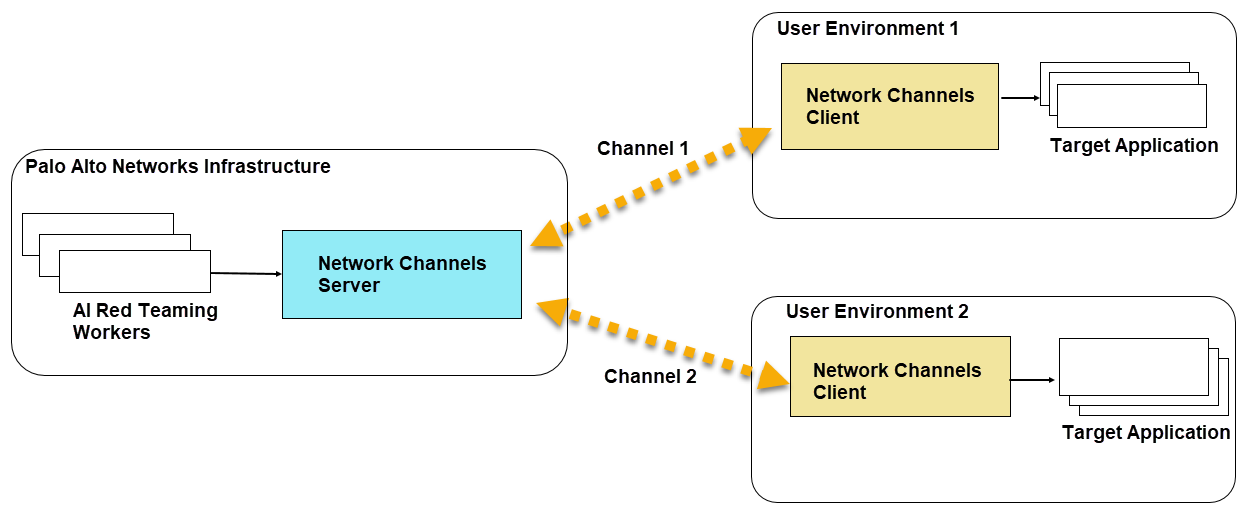
Additionally, you will be provided with a docker pull secret from Strata
Cloud Manager, which you can use to pull the docker image and helm chart for the
network channels client.
This combined solution is ideal for:
- Restricted Environments: Conducting assessments for enterprise users with air-gapped systems or strict compliance requirements.
- Continuous Monitoring: Maintaining reliable, persistent connectivity for real-time AI security updates.
- Automated Workflows: Deploying network broker clients across distributed infrastructure using existing container orchestration (Kubernetes/Helm) without manual intervention.
- Enhanced Security: No need to expose internal endpoints or modify firewall rules.
- Complete Control: Initiate and terminate connections on demand.
- Easy Setup: Simple client installation process.
- Flexible Management: Create and manage multiple secure channels for different environments.
- Reusability: Use the same connection for multiple targets.
- Enterprise Ready: Designed for organizations with strict security requirements.
Remediation Recommendations for AI Red Teaming Risk Assessment
|
January 2026
Supported for:
|
The Recommendations feature enables you to seamlessly transition from
identifying AI system vulnerabilities through Red Teaming assessments to
implementing targeted security controls that address your specific risks. This
feature closes the critical gap between AI risk assessment and mitigation by
transforming vulnerability findings into actionable remediation plans. The
remediation recommendations can be found in all Attack Library and Agent Scan Reports.
When you conduct AI Red Teaming evaluations on your AI models,
applications, or agents, this integrated solution automatically analyzes the
discovered security, safety, brand reputation, and compliance risks to generate
contextual remediation recommendations that directly address your specific
vulnerabilities.
The generated contextual remediation recommendations include two distinct
components:
- Runtime Security Policy configuration: Rather than configuring runtime security policies through trial and error, you receive intelligent guidance that maps each identified risk category to appropriate guardrail configurations, such as enabling prompt injection protection for security vulnerabilities or toxic content moderation for safety concerns.
- Other recommended measures: The system identifies successfully compromised vulnerabilities, and provides the corresponding remediation measures by prioritizing them based on effectiveness and implementation feasibility, allowing you to eliminate manual evaluation and focus resources on high-impact fixes.
For organizations deploying AI systems in production environments, this
capability ensures that your runtime security configurations and remediation
measures are informed by actual risk insights rather than generic best practices,
resulting in more effective protection against the specific threats your AI systems
face.
The remediation recommendations appear directly in your AI Red Teaming scan
reports, providing actionable guidance. You can then manually create and attach the
recommended security profiles to your desired workloads, transforming AI risk
management from a reactive process into a proactive workflow that connects
vulnerability discovery with targeted protection.
AI Red Teaming Executive Reports
|
January 2026
Supported for:
|
When you conduct AI Red Teaming assessments, you often need to share results with
executive stakeholders like CISOs and CIOs who require high-level insights rather
than granular technical details. The exportable executive PDF report feature
addresses this need by transforming your AI Red Teaming assessment data into a
consumable format. You can now generate comprehensive PDF reports that consolidate
the essential information from the web interface, organized to highlight critical
takeaways and strategic insights in a format that can be shared easily with
executives. While security practitioners can leverage CSV and JSON export formats to
access detailed findings for remediation purposes, this PDF format is highly
valuable for CXOs who intend to understand high level risk assessment of any AI
system.
Use this feature to communicate security posture and risk assessments to
executive leadership who may not have the time or technical background to parse
through detailed CSV exports or navigate complex web interfaces. The PDF format
ensures you can easily distribute reports through email or include them in executive
briefings and board presentations. The report contains AI summary, key risk
breakdown, high-level overview charts, and metrics that matter most to
decision-makers.
You can use this feature when preparing for executive reviews, board
meetings, or any scenario where you need to demonstrate the effectiveness of your
security controls and communicate risk exposure to non-technical stakeholders. The
structured format with AI summary, overview sections, and detailed attack tables,
ensures that both strategic insights and supporting technical evidence are readily
accessible, enabling informed decision-making at the executive level.
AI Summary for AI Red Teaming Scans
|
January 2026
Supported for:
|
When you complete an AI Red Teaming scan, you receive an AI Summary (in the
scan report) that synthesizes key risks and their implications. This executive
summary eliminates the need for manual interpretation of technical data, allowing
you to quickly understand which attack categories or techniques pose the greatest
threats to your systems and what the potential business impact might be.
The AI Summary contains the scan
configuration, key risks, and implications.
This capability is particularly valuable when you need to communicate AI
risk assessment results across different organizational levels or when preparing
briefings for leadership meetings. Rather than struggling to translate technical
vulnerability reports into business language, you can rely on the AI Red Teaming
generated report to articulate security, safety, compliance, brand, and business
risks in terms that resonate with executive audiences. This summary is also valuable
in prioritising remediation measures which teams can adopt for a safer deployment of
AI systems in production.
Enhanced AI Red Teaming with Brand Reputation Risk Detection
|
January 2026
Supported for:
|
You can now assess and protect your AI systems against Brand reputation
risks using Prisma AIRS enhanced AI Red Teaming capabilities. This feature addresses
a critical gap in AI security by identifying vulnerabilities that could damage your
organization's reputation when AI systems interact with users in production
environments. Beyond the existing Security, Safety, and Compliance risk categories,
you can now scan for threats including Competitor Endorsements, Brand Tarnishing
Content, Discriminating Claims, and Political Endorsements.
The enhanced agent assessment capabilities
automatically generate goals focused on Brand Reputational risk scenarios that could
expose your organization to public relations challenges or regulatory scrutiny. You
benefit from specialized evaluation methods designed to detect subtle forms of reputational risk,
including false claims and inappropriate endorsements that traditional security
scanning might miss. This comprehensive approach allows you to proactively identify
and address potential brand vulnerabilities before deploying AI systems to
production environments, protecting both your technical infrastructure and corporate
reputation in an increasingly AI-driven business landscape.
Error Logs and Partial Scan Reports
|
December 2025
Supported for:
|
When you conduct AI Red Teaming scans using Prisma AIRS, you may encounter
situations where scans fail completely or complete only partially due to target
system issues or connectivity problems. The Error Logs and Partial Scan Reports feature provides you
with comprehensive visibility into scan failures and enables you to generate
actionable reports even when your scans don't complete successfully. You can access
detailed error logs directly within the scan interface, both during active scans on
the progress page and after completion in the scan logs section, allowing you to
quickly identify whether issues stem from your target AI system or the Prisma AIRS
platform itself.
This feature particularly benefits you when conducting Red Teaming
assessments against enterprise AI systems that may have intermittent availability or
response issues. When your scan completes the full simulation but doesn’t receive
valid responses for all attacks, AI Red Teaming marks it as partially complete
rather than failed. You can then choose to generate a comprehensive report based on
the available test results, giving you valuable security insights even from
incomplete assessments. AI Red Teaming transparently informs you about credit
consumption before report generation and clearly marks any generated reports as
partial scans, indicating the percentage of attacks that received responses.
By leveraging this capability, you can maximize the value of your Red
Teaming efforts, troubleshoot scanning issues more effectively, and maintain
continuous security assessment workflows even when facing target system limitations
or temporary connectivity challenges during your AI security evaluations.
Automated AI Red Teaming
|
October 2025
Supported for:
|
Palo Alto Networks' is an automated solution designed to scan any AI
system—including LLMs and LLM-powered applications—for safety and security
vulnerabilities.
The tool performs a Scan against a specified Target (model,
application, or agent) by sending carefully crafted attack prompts to
simulate real-world threats. The findings are compiled into a comprehensive Scan
Report that includes an overall Risk Score (ranging from 0 to 100),
indicating the system's susceptibility to attacks.
Prisma AIRS offers three distinct scanning modes for thorough assessment:
- Attack Library Scan: Uses a curated, proprietary library of predefined attack scenarios, categorized by Security (e.g., Prompt Injection, Jailbreak), Safety (e.g., Bias, Cybercrime), and Compliance (e.g., OWASP LLM Top 10).
- Agent Scan: Utilizes a dynamic LLM attacker to generate and adapt attacks in real-time, enabling full-spectrum Black-box, Grey-box, and White-box testing.
- Custom Attack Scan: Allows users to upload and execute their own custom prompt sets alongside the built-in library.
A key feature of the service is its single-tenant deployment model, which
ensures complete isolation of compute resources and data for enhanced security and
privacy.